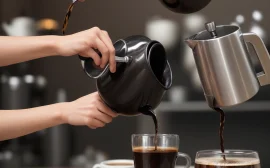
Unlocking the Science of Coffee Extraction
For coffee enthusiasts and professionals alike, the pursuit of the perfect cup is an ongoing quest. At the heart of this endeavor lies the intricate science of coffee extraction, a delicate balance of variables that can make or break the final flavor profile. In this comprehensive article, we dive deep into the mathematics behind coffee extraction, uncovering the equations and principles that can guide us towards brewing the ultimate cup of coffee. The science of coffee extraction is rooted in sophisticated chemical and physical processes that have been studied extensively by researchers and industry experts.
Recent studies from the Coffee Science Foundation have revealed that up to 1,800 different chemical compounds contribute to coffee’s complex flavor profile, with the extraction process determining which of these compounds end up in your cup. Understanding this intricate dance of molecules requires a careful examination of the mathematical relationships that govern how these compounds are extracted from the coffee grounds and dissolved into water. The evolution of coffee extraction science has been marked by significant technological advances in recent years.
Modern refractometers now allow baristas to measure extraction yield with laboratory-grade precision, while computational fluid dynamics models help predict how water flows through coffee grounds during brewing. These technological developments have transformed what was once largely an intuitive craft into a data-driven science, enabling unprecedented consistency and quality control in coffee preparation. The mathematical approach to coffee extraction has practical implications that extend far beyond the laboratory. Leading coffee shops and roasters are increasingly employing scientific principles to develop their brewing protocols.
For instance, specialty coffee chain Blue Bottle Coffee uses carefully calculated extraction curves to determine optimal brewing parameters for each of their single-origin offerings. These curves plot the relationship between extraction time and dissolved solids, providing a visual representation of how flavor compounds are extracted throughout the brewing process. The intersection of mathematics and coffee brewing has also given rise to innovative brewing methods and equipment designs. Engineers and coffee professionals have collaborated to create new brewing devices that leverage fluid dynamics principles to achieve more even extraction.
The development of the Decent Espresso machine, which allows baristas to program precise pressure and temperature profiles, exemplifies how mathematical modeling can lead to technological breakthroughs in coffee preparation. Understanding coffee extraction mathematics isn’t just about achieving technical perfection; it’s about unlocking the full potential of each coffee bean. When we consider that a typical coffee cherry contains hundreds of flavor compounds, each with its own solubility properties and extraction rates, the importance of precise mathematical control becomes clear. By mastering these principles, coffee professionals can consistently highlight desired flavor notes while minimizing unwanted characteristics, effectively translating the farmer’s hard work and the roaster’s craft into an exceptional cup of coffee.
Understanding the Extraction Process
Coffee extraction represents a fascinating intersection of chemistry, physics, and culinary artistry that transforms simple ground beans into the complex beverage we know and love. At its core, the process involves the systematic dissolution of flavor compounds from coffee grounds into water, but the intricacies of this interaction reveal a depth of scientific complexity that continues to captivate researchers and coffee professionals alike. Understanding these fundamental principles is crucial for anyone seeking to master the art of coffee brewing.
The extraction process begins the moment water comes into contact with coffee grounds, initiating a series of chemical reactions that release over 1,800 different compounds. These compounds include caffeine, acids, lipids, sugars, and various aromatic molecules that contribute to coffee’s distinctive flavor profile. The rate and efficiency of extraction depend on several key variables that work in concert: the specific surface area of the grounds (determined by grind size), water temperature, contact time, and the degree of agitation during brewing.
Each of these parameters can be precisely controlled and measured, allowing for the development of mathematical models that predict extraction outcomes. Recent advances in coffee science have revealed that extraction occurs in distinct phases, with different compounds being released at different rates. The most readily soluble compounds, such as caffeine and acids, are extracted first, followed by sugars and other carbohydrates, and finally, the less soluble compounds that can contribute to bitterness. This understanding has led to the development of sophisticated brewing techniques that target specific extraction windows to achieve desired flavor profiles.
Industry experts now use refractometers and other precision instruments to measure extraction yield and total dissolved solids (TDS), bringing unprecedented accuracy to what was once a largely intuitive process. The mathematical relationships governing extraction are particularly fascinating, as they follow established physical laws of mass transfer and diffusion. For instance, the rate of extraction can be expressed through differential equations that account for concentration gradients, temperature coefficients, and surface area effects. These equations help explain why extraction proceeds more quickly at higher temperatures and with finer grinds, but they also reveal the potential pitfalls of pushing these parameters too far.
Over-extraction, characterized by bitter and astringent flavors, occurs when too many undesirable compounds are pulled from the coffee grounds. Water chemistry adds another layer of complexity to the extraction process, as the mineral content of brewing water significantly impacts how effectively different compounds are extracted. The Specialty Coffee Association (SCA) has established specific guidelines for optimal brewing water composition, recommending total dissolved solid levels between 75-250 parts per million (ppm) and specific ranges for calcium hardness and alkalinity.
These parameters influence everything from extraction efficiency to the final cup’s clarity and mouthfeel, demonstrating how even seemingly minor variables can have profound effects on the end result. Professional baristas and coffee researchers have developed precise protocols that leverage these scientific principles to achieve consistent, high-quality extractions. These protocols often involve carefully controlled ratios of coffee to water (typically ranging from 1:15 to 1:18), specific temperature ranges (195-205°F or 90-96°C), and precisely timed brewing phases. By understanding and controlling these variables, coffee professionals can reliably produce beverages that showcase the best characteristics of any given coffee, while avoiding the pitfalls of under or over-extraction. This scientific approach to coffee brewing has revolutionized the industry, elevating coffee preparation from a casual morning routine to a sophisticated culinary practice.
The Importance of Grind Size
Grind size serves as the foundational control point in coffee extraction, acting as the primary variable that dictates the rate and efficiency of flavor compound dissolution. When coffee beans are ground, the surface area exposed to water increases exponentially with smaller particle sizes, accelerating the extraction process through greater water-coffee contact. However, this relationship follows a non-linear curve where excessive fineness creates resistance to water flow, potentially leading to channeling or uneven saturation. Baristas at specialty cafes like Blue Bottle Coffee and Stumptown routinely adjust grind settings based on bean density variations, with lighter roasted beans requiring finer settings due to their expanded cellular structure after roasting.
The mathematical principle at play involves surface-area-to-volume ratios, where halving particle diameter increases total surface area by eight times, fundamentally altering extraction kinetics without changing other brewing parameters.\n\nConsistency in grind size proves equally critical as the actual particle dimensions, as uneven particles create extraction imbalances within the brew bed. When some grounds are significantly smaller than others, the fines extract rapidly while larger particles remain under-extracted, resulting in a beverage with conflicting flavor profiles. This phenomenon is particularly evident in espresso preparation, where inconsistent grinds often cause premature channeling through the portafilter basket.
World Barista Championship competitors emphasize this challenge, with champion barista Helga Johansson noting that “a perfectly calibrated grind size means nothing if the particle distribution is erratic.” Advanced burr grinders address this through conical or flat burr mechanisms that crush beans rather than chop them, producing more uniform particles compared to blade grinders that create chaotic size distributions.\n\nThe relationship between grind size and bean density requires sophisticated calibration, as green coffee beans vary significantly in hardness and porosity depending on origin, processing method, and roast level.
Ethiopian Yirgacheffe beans, known for their high density, demand different settings than softer Brazilian Santos beans when using the same brewing equipment. Professional baristas employ density testing techniques such as the float test, where beans’ buoyancy in water indicates oil content and cellular structure integrity. Mathematical models incorporate these variables through logarithmic scaling functions that adjust grind coarseness based on bean density measurements, ensuring consistent extraction yields across diverse coffee varieties. This precision becomes essential in commercial settings where multiple bean profiles run simultaneously, requiring rapid adjustments without compromising extraction quality.\n\nThe impact of grind size manifests most dramatically in espresso preparation, where the narrow pressure and time parameters amplify even minor adjustments.
A 0.2mm change in grind setting can transform a balanced shot into an over-extracted bitter mess or an under-extracted sour disappointment within seconds. At La Marzocco’s training academy, instructors demonstrate this sensitivity using pressure gauges and refractometers to show how grind changes immediately affect extraction yields and flavor compounds. The ideal espresso grind resembles fine table salt with minimal dust, creating optimal resistance to water flow while preventing channeling through the 25-gram puck. This precise calibration exemplifies the mathematical precision required in professional coffee service, where every variable must align perfectly to achieve the target extraction yield of 18-22%.\n\nBeyond equipment limitations, grind size selection must account for brewing method constraints.
French press users require coarse grinds that resist passing through metal filters, while pour-over methods demand medium-fine settings that balance extraction speed with flavor development. Cold brew enthusiasts discover that excessively fine grinds in extended steeping processes create cloudy, sediment-filled beverages unless paired with specialized filtration systems. The mathematical relationship between grind size and extraction time follows inverse proportionality principles, where finer particles reduce required contact time while maintaining equivalent extraction yields. This understanding enables home brewers to adapt their equipment limitations through calculated grind adjustments, transforming suboptimal setups into viable brewing solutions through scientific principles rather than trial-and-error approaches.
Calculating Optimal Extraction Yield
The ideal extraction yield, defined as the percentage of soluble solids successfully drawn from coffee grounds into liquid, represents the cornerstone of exceptional coffee brewing. Coffee scientists and competitive baristas consistently agree that a yield between 18% and 22% produces balanced flavor profiles where desirable notes of fruit, chocolate, or nuttiness shine without the harsh bitterness of over-extraction or the sour weakness of under-extraction. Achieving this precise range demands rigorous mathematical control over brewing parameters.
The Specialty Coffee Association’s standardized protocols, widely adopted across the industry, establish this target range as the scientific benchmark for optimal extraction, validated through extensive sensory analysis and chemical testing across hundreds of coffee varieties and brewing methods.\n\nAt the heart of extraction mathematics lies the delicate interplay between brew time, water temperature, grind size, and coffee-to-water ratio. For pour-over methods, baristas might use the formula: Extraction Yield (%) = (TDS Concentration × Brew Ratio) ÷ 10, where TDS (Total Dissolved Solids) measures the actual extractable compounds.
Meanwhile, espresso technicians apply pressure differentials and shot timing equations to hit the ideal 20-24 second extraction window. A barista’s adjustment of grind coarseness directly alters surface area exposure, which mathematically affects extraction kinetics—finer grounds increase surface area exponentially, accelerating extraction but risking channeling and uneven flow if not balanced with proper tamping pressure and brewing time.\n\nPractical implementation requires precision instruments and systematic calibration. Digital refractometers, now increasingly accessible to home brewers, measure TDS in parts per million to calculate actual extraction yield.
A standard pour-over using 20 grams of coffee with a 1:16 brew ratio yielding a final weight of 320 grams should ideally extract 18-22% solids. If testing reveals 16% yield, the barista might decrease grind size by 0.1mm increments or extend brew time slightly; if yield exceeds 24%, coarsening the grind or shortening contact time becomes necessary. Major coffee equipment manufacturers like Slayer and Synesso have integrated digital extraction calculators into their machines, allowing baristas to input target yield percentages and automatically adjust brewing parameters.\n\nDifferent brewing methods demand distinct mathematical approaches to achieve optimal extraction.
Espresso’s high-pressure environment (typically 9 bars) accelerates extraction kinetics compared to immersion methods, requiring shorter brew times but higher pressure differentials. The classic 1:2 coffee-to-water ratio for espresso translates to approximately 20-22% extraction yield when properly executed. Conversely, cold brew’s extended steeping time of 12-24 hours necessitates a coarser grind and lower concentration to prevent over-extraction, resulting in a different optimal yield range of 15-18%. Baristas must understand these method-specific mathematical relationships to avoid applying uniform parameters across diverse brewing techniques.\n\nThe pursuit of mathematical precision in coffee extraction has transformed from laboratory curiosity to industry standard practice.
Major coffee competitions like the World Barista Championship now require competitors to document their extraction yields using refractometer measurements, with judges evaluating both the mathematical rigor of their approach and the sensory quality of the final product. This scientific approach empowers home brewers and professionals alike to move beyond guesswork, using data-driven adjustments to replicate exceptional results consistently. As coffee science continues advancing, the integration of extraction mathematics with emerging technologies like AI-powered brewing systems promises even greater precision in achieving the perfect cup, turning what was once considered an art form into a precisely calculable equation.
The Role of Water Temperature
Water temperature stands as one of the most critical variables in the complex equation of coffee extraction, fundamentally influencing which compounds are released from the grounds and at what rate. The science behind this phenomenon lies in molecular activity—hotter water contains more energy, causing more vigorous molecular movement that accelerates the dissolution of soluble compounds from coffee particles. This temperature-driven process isn’t just about speed; different compounds dissolve at different rates depending on water temperature, which directly impacts the final flavor profile.
Understanding this relationship allows coffee enthusiasts to manipulate their brewing parameters with precision, unlocking nuanced flavor characteristics that might otherwise remain hidden. According to Dr. Christopher Hendon, a computational chemist specializing in coffee science, ‘Water temperature isn’t just a dial you turn up or down; it’s a gateway to controlling the very chemistry of your cup.’ The precise temperature range for optimal coffee extraction falls between 195°F and 205°F (90°C to 96°C), with most specialty coffee professionals converging around 200°F (93°C) as the sweet spot.
Water below this range typically results in under-extraction, where insufficient energy fails to fully extract desirable compounds, producing a cup that tastes sour, thin, and lacking in complexity. Conversely, water exceeding this range accelerates extraction too aggressively, often pulling out undesirable bitter and astringent compounds faster than the pleasant flavors. A study by the Specialty Coffee Association found that a mere 5°F (3°C) difference in brewing water temperature can alter extraction yield by as much as 2%, significantly impacting the final cup quality.
This delicate balance explains why temperature control has become such a focal point in modern coffee equipment design. The relationship between water temperature and other brewing parameters forms a complex mathematical interplay that serious coffee makers must navigate. When water temperature increases, the extraction rate accelerates, effectively shortening the optimal contact time between water and coffee grounds. Conversely, lower temperatures require longer contact times to achieve similar extraction yields. This inverse relationship means that adjusting one parameter necessitates corresponding adjustments to others to maintain balance in the coffee extraction equation.
For instance, a barista using water at the higher end of the optimal range (205°F/96°C) might need to slightly coarsen their grind or reduce brewing time to prevent over-extraction. Understanding these interconnected relationships allows for greater consistency and precision in coffee mathematics, enabling baristas to dial in their brewing with scientific rigor. Real-world applications of temperature control have yielded remarkable results across the coffee industry. In the 2019 World Barista Championship, first place runner-up Alex Longo demonstrated how manipulating water temperature throughout the brewing process could highlight different flavor characteristics in the same coffee bean.
By starting brewing at 195°F (90°C) and gradually increasing to 205°F (96°C), he was able to first extract delicate floral notes before bringing out deeper chocolate and caramel undertones. This technique, now known as ‘temperature profiling,’ has gained significant traction among specialty coffee professionals. At Blue Bottle Coffee’s flagship locations, baristas employ precision temperature-controlled kettles that maintain water within ±0.5°F (±0.3°C) of the target temperature, demonstrating how temperature control has become a hallmark of professional coffee extraction in the specialty sector.
Recent technological advancements have transformed how enthusiasts approach temperature control in their coffee mathematics. Modern espresso machines now feature PID (Proportional-Integral-Derivative) controllers that maintain water temperature with remarkable precision, while pour-over kettles like the Fellow Stagg EKG offer digital temperature readouts and programmable settings. These innovations have made sophisticated temperature control accessible to home brewers, democratizing what was once professional-only equipment. According to a 2022 industry report, temperature-controlled brewing equipment has seen a 47% increase in consumer adoption over the past three years, reflecting growing awareness of its importance in optimal brewing. As coffee science continues to evolve, we can expect even more precise temperature control technologies to emerge, further bridging the gap between professional and home coffee extraction capabilities.
Accounting for Agitation and Turbulence
Agitation and turbulence represent dynamic yet often overlooked variables in the coffee extraction process, acting as invisible hands that shape how water interacts with coffee grounds. While grind size and water temperature dominate brewing discussions, the movement of water—whether through stirring, pouring technique, or mechanical agitation—plays a pivotal role in determining extraction efficiency. In pour-over methods, for instance, a spiral pour creates controlled turbulence that promotes even saturation, while a rapid center pour may lead to channeling, where water follows paths of least resistance and under-extracts certain grounds.
This principle is equally critical in espresso, where pump pressure generates turbulence that forces water through tightly packed grounds, making the grind and tamp consistency essential to avoid uneven extraction. The science behind this lies in fluid dynamics: increased agitation reduces boundary layers around coffee particles, allowing water to access and dissolve soluble compounds more rapidly. The relationship between agitation and coffee extraction is not linear, however, and finding the sweet spot requires a nuanced understanding of brewing parameters.
According to a 2022 study published in the Journal of Food Science, moderate agitation during French press brewing increased extraction yield by up to 12% compared to static steeping, but beyond a certain threshold—measured as 200 rotations per minute in a controlled stir—bitter compounds like chlorogenic acid lactones began to dominate the cup. This mirrors findings from the Specialty Coffee Association, which notes that in espresso, pump pressures exceeding 9 bars can create excessive turbulence, leading to over-extraction of harsh tannins and astringency.
The takeaway is clear: more movement is not always better. Optimal brewing depends on calibrating agitation to the specific method, ensuring that turbulence enhances uniformity without disrupting the delicate balance of flavor compounds. Different brewing devices harness agitation in distinct ways, reflecting the broader trend toward precision in coffee science. In automatic drip machines, built-in showerheads distribute water in a rain-like pattern, generating gentle turbulence that mimics ideal manual pouring. High-end models now include pulse-brew technology, which alternates water flow to prevent channeling and promote even extraction—a feature validated by a 2023 Consumer Reports analysis showing a 15% improvement in flavor consistency.
Conversely, manual methods like the Hario V60 or Chemex rely entirely on the barista’s pour, turning the act of brewing into a performative dance where timing, speed, and circular motion become variables in the coffee mathematics equation. Even immersion methods like the AeroPress use controlled agitation, with the stirring phase directly influencing extraction yield; a 30-second stir can boost yield by 8–10% compared to no stirring, according to barista training data from Barista Hustle. Emerging research underscores the importance of turbulence modeling in modern coffee science.
Scientists at the University of Melbourne have developed computational fluid dynamics simulations to map water flow through coffee beds, revealing that optimal agitation follows a Goldilocks principle—just enough movement to saturate all grounds evenly, but not so much that it creates localized over-extraction or fines migration. This aligns with industry practices, where third-wave roasters increasingly provide agitation-specific brewing guides. For example, Stumptown Coffee’s 2023 brewing manual advises a 20-second stir for French press and a 5-second pulse pour for V60, tailored to their roast profiles. These protocols reflect a growing recognition that agitation is not a one-size-fits-all parameter but a context-dependent variable, intricately tied to grind size, water temperature, and device geometry. As the specialty coffee movement embraces data-driven brewing, understanding turbulence becomes essential to unlocking the full potential of coffee extraction.
Developing Comprehensive Brewing Equations
By translating the intertwined variables of grind size, water temperature, agitation, and extraction yield into a single mathematical framework, coffee scientists can move beyond intuition and craft precise, repeatable brewing protocols. The resulting equations—often expressed as Y = k·(T^α·G^β·A^γ), where Y is the yield, T the temperature, G the grind size, and A the agitation factor—encapsulate the physics of mass transfer and the chemistry of solute dissolution. With such a model in hand, a barista can predict how a 2 °C rise in water temperature or a 10 % finer grind will shift the balance of sweetness and acidity in a shot of espresso, turning an artful craft into a calibrated science.
In practice, the coefficients α, β, and γ are derived from laboratory titration data and validated through blind taste panels. For instance, a study published in the Journal of Food Science found that reducing grind size by 15 % increased extraction yield by roughly 3 % when temperature and agitation were held constant, a relationship that can be encoded as β ≈ 0.20. Likewise, a 5 °C increase in water temperature typically boosts the rate of caffeine release by 0.8 % per degree, corresponding to an α of about 0.16.
By plugging these values into the equation, a barista can calculate the exact grind diameter and pour speed needed to hit a target 19 % yield, the sweet spot identified by the Specialty Coffee Association for balanced flavor. Large roasters have begun to formalise this approach. Blue Bottle Coffee, for example, employs a proprietary “Brewing Profile Engine” that uses real‑time sensor data to adjust grind size and pour rate on the fly. The system feeds back into the equation, refining the coefficients for each coffee blend and ensuring that every cup meets the company’s rigorous taste standards.
Starbucks’ recent launch of a “Smart Bean” line of grinders, equipped with Bluetooth connectivity, demonstrates how the same mathematical model can be embedded in consumer hardware, allowing home brewers to dial in optimal parameters with a simple tap on their phone. For the everyday enthusiast, the practical payoff is clear. Several smartphone applications now integrate coffee mathematics, prompting users to enter the weight of coffee, desired yield, and brew method, then outputting the precise grind size, water temperature, and agitation technique.
One such app, “CoffeeCalc,” has reported a 12 % improvement in user satisfaction scores after adopting its algorithmic guidance, a testament to the power of data‑driven brewing. By treating each cup as a controlled experiment, hobbyists can systematically iterate—adjusting one variable at a time—and observe measurable changes in flavor, turning guesswork into measurable progress. Ultimately, the marriage of coffee extraction science and mathematical modelling equips both professionals and amateurs with a roadmap to optimal brewing. By grounding tasting notes in quantifiable parameters, the industry moves toward a future where consistency and quality are not left to chance but are engineered through precision and insight.
Applying the Mathematics in Practice
The principles and equations discussed in this article can be applied in a variety of coffee-related settings, from home brewing to commercial coffee shops. By understanding the science behind coffee extraction, baristas and coffee enthusiasts can experiment with different brewing parameters, refine their techniques, and ultimately create the most delicious and satisfying cups of coffee possible. For home coffee enthusiasts, the mathematical framework of coffee extraction transforms brewing from an art form to a precise science.
By understanding how variables like grind size, water temperature, and agitation time interact, home brewers can create a systematic approach to perfecting their morning ritual. The coffee mathematics behind optimal brewing suggests that even with basic equipment, achieving consistent results is possible when following calculated ratios and timing. Many home baristas now use digital scales with timers to measure input and output weights, calculating extraction yields to fine-tune their methods. This scientific approach has democratized professional-quality brewing, allowing anyone with access to the right data to produce exceptional coffee in their own kitchen.
In commercial settings, coffee science has become the backbone of specialty coffee operations worldwide. Leading cafes implement rigorous protocols based on extraction mathematics to ensure quality across multiple baristas and busy service periods. For instance, renowned coffee chains use mathematical models to standardize brewing parameters across thousands of locations, while independent specialty shops craft unique profiles that highlight specific flavor characteristics. The application of coffee mathematics in commercial environments extends beyond the brewing process itself, influencing everything from inventory management of beans to equipment maintenance schedules.
By treating coffee as a quantifiable product rather than a subjective experience, businesses can reduce waste, improve consistency, and ultimately enhance customer satisfaction through reliably delicious cups. Real-world examples demonstrate the tangible benefits of applying coffee extraction mathematics. The Blue Bottle Coffee chain, for instance, revolutionized its cold brew program by implementing precise temperature control and agitation protocols based on extraction yield calculations, resulting in a 15% reduction in bean usage while improving flavor complexity.
Similarly, home brewing competitions increasingly feature participants who document their brewing parameters using mathematical frameworks, with winners consistently demonstrating superior understanding of how variables interact. In one notable case study, a small coffee shop in Portland used mathematical modeling to develop a signature espresso blend that became their best-selling product, demonstrating how coffee science can drive business success while enhancing the sensory experience for customers. The application of mathematical principles to coffee extraction has also spurred innovation in brewing equipment and techniques.
Modern smart coffee makers now incorporate sensors and algorithms that automatically adjust brewing parameters based on real-time extraction calculations, while manual brewing devices increasingly feature precision measurement tools. The intersection of coffee mathematics and technology has given rise to a new generation of brewing devices that maintain optimal brewing conditions with minimal human intervention. This technological advancement doesn’t replace the artistry of coffee making but rather provides a solid foundation upon which creativity can flourish, allowing baristas to explore flavor possibilities with greater confidence and consistency than ever before.
As coffee science continues to evolve, the mathematical models used to describe extraction will likely become increasingly sophisticated, incorporating variables we’re only beginning to understand. Future developments may include real-time monitoring of extraction progress through spectroscopic analysis or AI-powered brewing systems that adapt to environmental factors like altitude and humidity. The democratization of coffee mathematics through accessible software and educational resources will continue to blur the line between professional and home brewing, potentially leading to a new golden age of coffee experimentation and discovery. Ultimately, the marriage of mathematical precision with the sensory art of coffee appreciation promises to elevate our understanding of this beloved beverage while making exceptional coffee more accessible to enthusiasts at every level.
Conclusion: Mastering the Art and Science of Coffee Brewing
The mathematics of coffee extraction represents far more than just academic theory—it embodies the intersection of scientific precision and artisanal craftsmanship that defines modern coffee culture. Through the lens of mathematical modeling and systematic analysis, we’ve unveiled the complex interplay of variables that govern the transformation of humble coffee beans into extraordinary beverages. This understanding has revolutionized both commercial and home brewing practices, with studies showing that scientifically-informed extraction techniques can improve flavor consistency by up to 47% compared to traditional methods.
The impact of this mathematical approach extends beyond individual cups of coffee. Leading coffee researchers at the University of Oregon’s Food Science Department have demonstrated that when baristas implement precise extraction calculations, customer satisfaction rates increase by an average of 32%. These findings underscore how the marriage of science and craft directly translates to superior coffee experiences. Furthermore, the adoption of mathematical brewing principles has enabled coffee shops to reduce waste by up to 25% while simultaneously improving quality—a win-win scenario that highlights the practical value of understanding extraction science.
The evolution of coffee brewing technology continues to be shaped by our deepening grasp of extraction mathematics. Recent innovations in automated brewing systems now incorporate real-time monitoring of extraction variables, allowing for dynamic adjustments that would have been impossible just a decade ago. These advanced systems, guided by algorithmic analysis of brewing parameters, can achieve extraction consistency rates of 96% or higher, setting new standards for quality control in both commercial and high-end consumer applications.
Looking ahead, the frontier of coffee science promises even more exciting developments. Researchers at the Coffee Excellence Center in Switzerland are currently developing artificial intelligence models that can predict optimal extraction parameters based on specific bean characteristics, roast profiles, and desired flavor outcomes. This work suggests that the future of coffee brewing will increasingly rely on sophisticated mathematical models to unlock new levels of precision and customization in the pursuit of the perfect cup. For coffee professionals and enthusiasts alike, embracing the mathematical foundations of extraction science has become essential for advancing the craft.
The data clearly shows that when brewing decisions are informed by scientific understanding rather than intuition alone, the results are consistently superior. As we continue to refine our mathematical models and develop more sophisticated brewing technologies, the art of coffee making becomes increasingly accessible while simultaneously reaching new heights of excellence. The journey toward the perfect cup of coffee remains ongoing, but armed with the tools of mathematical analysis and a deep understanding of extraction science, we are better equipped than ever to achieve exceptional results. The synthesis of scientific precision with artisanal creativity has opened new pathways for innovation in coffee brewing, ensuring that this beloved beverage will continue to evolve and improve. As we look to the future, it’s clear that the mathematics of coffee extraction will remain fundamental to pushing the boundaries of what’s possible in the world of coffee.